Monday, June 13, 2016


Saturday, May 24, 2014
Poetic Tribute to a Veteran
Fitting for this Memorial Day weekend. I recently wrote this brief poem after visiting a very old and ill man at NHC Healthcare in Glasgow. --
Down the lonely hall is the sick and struggling man.
I seek to place some final comfort in the stranger's hand.
With pictures of his battleship prominently on the wall,
I learned the gentle soul was an old warrior, after all.
Downcast I addressed him, humble in my stance,
confessing I had never gone to fight in foreign lands.
Then blushed with sincerity, precise with his aim,
he comforted me that there was no reason for my shame.
He fought against injustice, he fought tyranny.
Now he fights the devils whispering defeat to me.
So quick! Rush to his flank! Clutch his hand today!
Because another old warrior is about to fade away.
Down the lonely hall is the sick and struggling man.
I seek to place some final comfort in the stranger's hand.
With pictures of his battleship prominently on the wall,
I learned the gentle soul was an old warrior, after all.
Downcast I addressed him, humble in my stance,
confessing I had never gone to fight in foreign lands.
Then blushed with sincerity, precise with his aim,
he comforted me that there was no reason for my shame.
He fought against injustice, he fought tyranny.
Now he fights the devils whispering defeat to me.
So quick! Rush to his flank! Clutch his hand today!
Because another old warrior is about to fade away.
Sunday, February 16, 2014
The Trick Question about Marriage
"When did you stop beating your wife?" That's, of course, a trick question that will get you into trouble no matter how you answer. The whole gay marriage legal issue is even more a conundrum of confusion.
Think carefully about the recent federal court ruling that Kentucky's marriage law, upholding marriage as between a man and a woman, violates the U. S. constitution's 14th amendment.
Laws can't discriminate against any particular class of people, the federal judge ruled according to the constitution. Yes, homosexuals are a class of people. Hard to deny that. But it's also been hard to deny another stubborn reality; at least it remains incredibly hard for many, if not most, Kentuckians. The long historical definition of "marriage" as only between a man and a woman is the one that has fundamentally shaped the civic culture of Kentuckians and other Americans well before any of us were born. Many, if not most of us, just don't have the mental categories to perceive "marriage" any other way. At least we can conceive that what homosexuals are doing can be legitimately defined as "civil union" in a public sense, or perhaps furthermore as "loving commitment" in a personal sense. But "gay marriage," more than merely a legal struggle, forces us to preserve any sane trajectory of "logic" itself. More than ever before, words mean everything.
History also teaches us something else. Revolutions usually need confusing chaos from which the revolution's new categorical thinking and culture can arise. So now, you are either trying to sort out and assess the new logic of "gay marriage," or you are leaving the thinking to others. If you're among the latter, this is actually no longer a revolution for you. It might as well be life as you'll always know it from this point forward. What about the new normal?
Saturday, February 8, 2014
"God-olution." What's Wrong with This Word?"
What's wrong with the word "God-olution," besides the fact that I obviously just made it up? Well, quite a bit, I think.
An old friend just replied with interest in my previous blog post on evolution, creationism, and the Nye-Ham debate. He adheres to a view of origins called theistic evolution, and asked for my opinion on it.
First I'll admit that there are many intelligent, God-honoring Christians who are excellent scientists yet also theistic evolutionists. Among the most notable is Francis Collins, who directed the monumentally important and tedious Human Genome Project.
Theistic evolution basically asserts that God somehow and for some reason used the processes of evolution generally promoted by mainstream science to bring about complex life, including humans. But theistic evolution gets snagged by at least a couple of logical conundrums that cannot be cleared away, at least in my thinking.
On the one hand, there's the logic from mainstream evolutionary biologists themselves, the majority of whom dislike it. Most of them insist that evolutionary theory stay strongly entrenched in the thinking of scientific materialism (also called "naturalism") that, by definition, can in no way allow "a divine foot in the door." Otherwise, we open things up to the chaotic intellectual mess (according to them) of "God of the Gaps" thinking.
So, according to theistic evolution, biological changes that appear to be random mutations to the scientist are slight, intentional modifications by the deity to bring the organism along toward the ideal form He has in mind. When evolutionary leaps have occurred that science can't seem to explain, we just say God stuck His nose in the process, here and there from time to time, just to make sure His marvelous machine of nature stays on track toward His ultimate goals.
If this were true, according to most materialists, it would logically be a science stopper. Instead, all science must operate solely within the understanding of purely natural processes and laws that preclude any consideration of divine intentions or actions. It's best, most of them say, to keep religious (or even potentially theological) considerations outside of one's scientific method. Therefore, whenever you say "God did it!" to a materialist, he'll ask you if you want him to just throw off his smock, go home, and play Candy Crush the rest of his life. Most of them operate from a scientific philosophy, and arguably a broader worldview, that makes it impossible to mix any theism in with science.
On the other hand, theistic evolution is equally problematic from the direction of biblical logic. Even as a Christian, I think I can almost comprehend theistic evolution as technically plausible, yet it's still specious beyond rescue. Despite a history of many opposing interpretations of this and that in Scripture, biblical theists have always agreed on at least this biblical teaching: that God is in sovereign control of His own creative acts. Whether one is a "young earth" or "old earth" creationist, almost all agree that He is a God of order, intentionality, deliberation, purposive design. Despite our frail understanding of God and his sovereign acts, we affirm the Bible's teaching, beginning from Genesis 1:1 and onward, that there is absolutely nothing capricious in His own nature. Yet basic tenets of evolutionary science are random mutation advanced and preserved by blind, purposeless selection by nature alone. Randomness is a primary fabric explicitly woven into evolutionary science ever since Darwin. Any such "mindless" process contradicts the message that the Bible (and general revelation; a separate discussion) portrays about the Mindful, Deliberate Creator of Life.
An example that might help one consider the workings of theistic evolution hypothetically could be to somehow picture God spinning a metaphysical roulette wheel for every potential event that would actualize in nature. (Because, remember, chance is a necessary ingredient of evolutionary theory.) It seems He would have to perpetually spin it and spin it till just the right interactionary events come up in successive order for Him to then hold in place. Well, this seems like a really confusing and unfathomably inefficient means for God to fulfill His creative goals. Of course one could say, "He's God! He's sovereignly free to be as inefficient as He likes. Furthermore, His ways are not our ways!"
Yes, but let's prefer the simplest answer when it begs us to and not let theistic evolution make us try to swallow a camel unnecessarily. Okham's Razor should make Christian theists cut right to the understanding that God simply speaks His plans into existence by the power of His command. More importantly, a necessarily simple interpretation of Scripture cuts right to it. Such as, "The Lord by wisdom founded the earth, By understanding He established the heavens" (Proverbs 3:19). It's intuitive to reflect on creative power as a product of Wisdom and Understanding. But Randomness and Chance? Not a chance.
There's my take on this deep subject. I admit I've read very little in recent years on theistic evolutionary arguments. So, as always, if I've missed something important, misrepresented, or got something flat wrong, please respond and we'll keep this conversation going.
Friday, February 7, 2014
Creationism Kills the Economy. Really?
The recent, greatly anticipated debate between secular science apologist Bill Nye and young earth creationist Ken Ham certainly lived up to its billing. (Replay at debatelive.org.) My general take is each man argued his position on origins and geology pretty well. But the nitty-gritty arguments for old earth evolution or young earth biblical science are not the biggest headline. Broader warnings from Nye are what grabbed my attention the most.
Most importantly, Nye was not at all convincing when it came to his chief concern as a "mainstream" scientist out there in "the real world" who's greatly worried about science education of America's youth and it's effect on our nation's future. Specifically, he failed at showing a viable connection between skepticism of evolution and a weakening American economy. That's because there is no connection.
To the contrary, Ham easily demonstrated that Darwin doubters, even young earth creationists, contribute greatly to the advancement of practical scientific technologies. Among many notable examples, the inventor of medicine's MRI. So when it comes to actionable breakthroughs in mathematical engineering--nothing if not real science--any beliefs that these pioneers might have related to historical science of biological origins or the age of the earth is utterly perfunctory. Fretting about such beliefs as some kind of economic threat is a childish distraction. Evolution critics can help advance pragmatic, exciting science and improve our way of life as much as anyone, as long as they do the work their respective specialties demand. And Chicken Little's dollar will not fall because of them.
Secularists often say there is insufficient evidence to connect religious beliefs with clearly demonstrable events perceivable by all who live in "the real world." And so they confuse today's thinking, religious believers with the ancient mindset of, say, Ancient Greece; of believing in a capricious deity or in deities who magically zap the world with no intelligible rhyme, reason, or natural causation.
But it's Bill Nye who actually makes the muzziest of arguments, trying to force two entirely disjointed things together; doubts about Darwin and a collapse of the economy. Not really fitting for The Science Guy.
Most importantly, Nye was not at all convincing when it came to his chief concern as a "mainstream" scientist out there in "the real world" who's greatly worried about science education of America's youth and it's effect on our nation's future. Specifically, he failed at showing a viable connection between skepticism of evolution and a weakening American economy. That's because there is no connection.
To the contrary, Ham easily demonstrated that Darwin doubters, even young earth creationists, contribute greatly to the advancement of practical scientific technologies. Among many notable examples, the inventor of medicine's MRI. So when it comes to actionable breakthroughs in mathematical engineering--nothing if not real science--any beliefs that these pioneers might have related to historical science of biological origins or the age of the earth is utterly perfunctory. Fretting about such beliefs as some kind of economic threat is a childish distraction. Evolution critics can help advance pragmatic, exciting science and improve our way of life as much as anyone, as long as they do the work their respective specialties demand. And Chicken Little's dollar will not fall because of them.
Secularists often say there is insufficient evidence to connect religious beliefs with clearly demonstrable events perceivable by all who live in "the real world." And so they confuse today's thinking, religious believers with the ancient mindset of, say, Ancient Greece; of believing in a capricious deity or in deities who magically zap the world with no intelligible rhyme, reason, or natural causation.
But it's Bill Nye who actually makes the muzziest of arguments, trying to force two entirely disjointed things together; doubts about Darwin and a collapse of the economy. Not really fitting for The Science Guy.
Friday, November 29, 2013
"Oprah's Favorites to Complete Your List"
I am reminded more of my
lostness. I am incapable of determining the tasteful, the pertinent, the
Good on my own. Were I to pray for the archetypal experience of tea drinking
(I've always been a wayward coffee guy since my mother weened me from those white bottles of non-caffeination), or just to look into the
matter for any tea drinker on my Christmas shopping list, Oprah, of
course, would be the pedagogical authority on what is the Good tea
set to purchase. The tea sets at which I now peer through the mall shop
windows are not merely endorsed by O, they're actually her favorites.
Being an A-list celebrity must be exhausting. Your meditation constantly interrupted. Unenlightened seekers of wisdom like me endlessly scale your mountain of solace to have audience. You must fulfill our quests for the tasteful, the pertinent, the Good. Then, as it's stenciled on a storefront window, all can glean from "what is written." Mall pilgrims then glaze by, beyond, and, who knows, perhaps serendipitously into the church on any day but Sunday.
For you, Mr. or Ms. Consumer, it's not just your shopping list that can be completed. Now you absorb what before was universal secrecy. Mystery now neatly wraps the life worth living with such order and pretty paper that you'd never comprehended until the present moment. It's the moment when this year's (Curse last years!) styles, colors, and, of course, selection all come together to make inner sense. It all feels Good. So this object could be just the fit for the person on your list, who is of equal or greater value. Or so you tend to hope.
Heaven is made of stars, and we cast our spirits toward the stars--daytime and primetime--who descend from the fake living room sets or the celestial stadia. What paves the path that orients us heavenward bursts forth from the Scripture, Sermon and Evangelistic appeal of Branding. In Branding "we live, and move, and have our being." Come, sit and sip. No, be saturated by The Tea Set and so much more. But please stop in and drink today because supplies are limited. Equally mysterious.
Being an A-list celebrity must be exhausting. Your meditation constantly interrupted. Unenlightened seekers of wisdom like me endlessly scale your mountain of solace to have audience. You must fulfill our quests for the tasteful, the pertinent, the Good. Then, as it's stenciled on a storefront window, all can glean from "what is written." Mall pilgrims then glaze by, beyond, and, who knows, perhaps serendipitously into the church on any day but Sunday.
For you, Mr. or Ms. Consumer, it's not just your shopping list that can be completed. Now you absorb what before was universal secrecy. Mystery now neatly wraps the life worth living with such order and pretty paper that you'd never comprehended until the present moment. It's the moment when this year's (Curse last years!) styles, colors, and, of course, selection all come together to make inner sense. It all feels Good. So this object could be just the fit for the person on your list, who is of equal or greater value. Or so you tend to hope.
Heaven is made of stars, and we cast our spirits toward the stars--daytime and primetime--who descend from the fake living room sets or the celestial stadia. What paves the path that orients us heavenward bursts forth from the Scripture, Sermon and Evangelistic appeal of Branding. In Branding "we live, and move, and have our being." Come, sit and sip. No, be saturated by The Tea Set and so much more. But please stop in and drink today because supplies are limited. Equally mysterious.
Saturday, July 27, 2013
My Comments (& Others) at KyDeptEd Hearing on Proposed New Ky. Science Standards
I addressed the Ky Dept of Ed at the public hearing in Frankfort Tue, July 23, 2013
about the Next Generation Science Standards. My 5 minutes of comments
target the evolutionary biology aspect.
Here's the whole video of the KDE hearing. http://mediaportal.education.ky.gov/videos/kde-public-hearing-7232013/ I'm at 15:30 run time mark, the first one of about 20 or so to address the science standards. Nothing from me about fascism, murder, genocide, or the like, so I didn't make the Courier Journal's cut. You'll have to listen to some of the others to get that perspective.
Or, if you prefer to just read, my text is pasted below:
Here's the whole video of the KDE hearing. http://mediaportal.education.ky.gov/videos/kde-public-hearing-7232013/ I'm at 15:30 run time mark, the first one of about 20 or so to address the science standards. Nothing from me about fascism, murder, genocide, or the like, so I didn't make the Courier Journal's cut. You'll have to listen to some of the others to get that perspective.
Or, if you prefer to just read, my text is pasted below:
We and our Kentucky kids are
being misled. The Next Generation
Science Standards do not reflect all
the latest scientific research, at least the research on evolutionary theory—not
by a long shot. Much is not settled. And we’re being misled to assume all
opposition to this view of biology is a matter of religion.
Random mutation is not settled with Cambridge biochemist
Douglas Axe. He doesn’t talk about
religion, but his research in the Journal of Molecular Biology discusses how
amino acids fold up 3-dimensionally in just the right complex shapes to form
the exact kind of proteins needed to construct and do work in the living cell.
Axe says, among all the possible amino acid combinations, the probability of
random mutation generating just one short protein capable of folding and
remaining stable is roughly[[[[[[[ 1 in 10 to the 74th power, or ]]]]]]]]] one
chance in a hundred trillion, trillion, trillion, trillion, trillion,
trillion. Will our kids get to consider
this or anything else that challenges macroevolution by chance mutation and
natural selection?
Gerd Muller and Stuart Newman
published essays by several scientists wondering how neo-Darwinism could
explain the origin of epigenetic
information. [[[[[[[But when it comes to
comparing traits of various species,]]]]]]]]
the NGS standards over-emphasize genetic
similarities between species to prove macroevolution, and seem to overlook
these crucial epigenetic factors,
that is, microbiological factors that are not traced to genes, that determine
how organs are shaped and body plans come together. So, when it comes to evolutionary
microbiology, the writers of the NGSS are behind the curve.
[[[[[[[The truth is there are
a multitude of problems that have biologists branching off into all kinds of
competing theories that have to forsake Darwin, but preserve at least some kind
of evolutionary model.]]]]]]]
A group of leading
evolutionary biologists, known as the Altenberg 16, completely without
religious concerns [[[[[[except, perhaps, not
to be seen as religious]]]]]]]], are explicitly calling to toss out the old
for some new theory of evolution that might really work. If you’re afraid to teach our kids the controversy
and let them weigh some issues for themselves, then maybe we are raising them
to be intellectually weak.
It’s been said these
standards are unified by research in multiple fields.
Well, will our kids learn
what’s going on in Paleontology? Paul
Chien, University of San Francisco. He
doesn’t talk about religion, but he’s researched how Pre-Cambrian rock strata in
southern China have fossilized soft-bodied embryos. This helps to prove that the great number of
new species that suddenly arose in the Cambrian era have no evolutionary ancestors.
Darwin worried how the kind of fossil evidence that we have today could
eventually threaten his theory. Will our
students learn this?
Mathematics: John Lennox shows mathematic evidence to
question seriously how blind nature itself could have produced novel semantic
information necessary for the first biological life or new species to arise.
Now Lennox does believe in God, but he’s also professor of mathematics at this
quaint little college called Oxford.
There are Philosophers of
Science who are somewhere between admitted agnosticism or atheism, and yet say
challenges to Darwinism can have merit. These include Princeton-educated David
Berlinski, who also makes mathematic challenges, and Princeton-educated Bradley
Monton, now professor at University of Colorado at Boulder. New York University
philosopher Thomas Nagel says the current evolutionary paradigm based on
materialistic reductionism is bankrupt in explaining the existence of the mind.
Will our kids’ minds get exposed to this?
Cosmology: The late Allan Sandage, the twentieth
century’s most influential astronomer, conceded, "The world is too
complicated in all its parts and interconnections to be due to chance alone. [[[[[I
am convinced that the existence of life with all its order in each of its
organisms is simply too well put together." He did eventually become a
theist. (Cited by Lennox, 176). ]]]]]]]
I urge the KDE not only to
reject the NGS Standards related to evolutionary biology, but also to review
current state standards that do not adequately address these and other
substantive disagreements among real scientists. [[[[[[[These challenges are based on
observable research and analysis, not religious agendas. If you made your decision to pass the NGSS
without weighing these scholars' arguments with at least a cursory understanding,
then now’s the time.]]]]]]] Are our kids being prepared to wrestle through the controversy
behind such an important issue while considering the different sides? If not, they’re really not becoming educated.
This has everything to do
with our school childrens’ understanding of their own significance and what
purpose is behind their own lives. It’s
more than just science. We can’t get
this wrong. The gravity of the
theoretical domain of evolution demands that you burn the midnight oil in comprehending
these arguments. Because the writers of
the NGSS are either misleading us or they themselves are underprepared and
underinformed.
5:30 [[[[[[4:40]]]]]]
References:
Axe, DD. “Estimating the prevalence of protein
sequences adopting functional enzyme folds.” In J Mol Biol. 2004 Aug 27;341(5):1295-315.
Berlinski, David. “The
Deniable Darwin.” Commentary 101 (1996): 19– 29.
_______. “On Assessing
Genetic Algorithms.” Public lecture, “Science and Evidence of Design in the
Universe” Conference, Yale University, November 4, 2000.
Britten, Roy J., and Eric H.
Davidson. “Gene Regulation for Higher Cells: A Theory.” Science 165 (1969): 349-57.
Chien, Paul, J. Y. Chen, C.
W. Li, and Frederick Leung. “SEM Observation of Precambrian Sponge Embryos from
Southern China, Revealing Ultrastructures Including Yolk Granules, Secretion
Granules, Cytoskeleton, and Nuclei.” Paper presented to the North American
Paleontological Convention, University of California, Berkeley, June 26– July
1, 2001.
Lennox, John C. God’s Undertaker: Has Science Buried God?
Oxford: Lion, 2009. Chapters 9-11.
Mazur, Suzan. The Altenberg 16: An Exposé of the Evolution
Industry. Berkeley, CA: North
Atlantic Books, 2010.
Monton, Bradley. Seeking God in Science: An Atheist Defends
Intelligent Design. Buffalo, NY:
Broadview, 2009.
Müller, Gerd B., and Stuart
A. Newman. “Origination of Organismal
Form: The Forgotten Cause in Evolutionary Theory.” In Organization
of Organismal Form: Beyond the Gene in Developmental and Evolutionary Biology,
edited by G.B. Müller and S. A. Newman, 3-10. Cambridge, MA: MIT Press, 2003.
Nagle, Thomas. Mind & Cosmos: Why the Materialist
Neo-Darwinian Conception of Nature Is Almost Certainly False. New
York: Oxford University Press, 2012.
Shapiro, Jams A. Evolution: A View from the 21st Century.
Upper Saddle River, NJ: FT Press Science, 2011.
Saturday, June 29, 2013
The Disconnect Between Gay Marriage and the Civil Rights Movement
Even before the historic U.S. Supreme Court decisions last week on DOMA and Prop 8, many, if not most, gay marriage supporters have seen the movement as a continuation of the black civil rights movement. Justification to do so has a problem (among others). To understand this particular logical problem, we must consider the specific things African Americans and other minorities were denied access to leading to the racial civil rights movement and contrast those things with "marriage" as generally understood in our civic and religious culture.
Rosa Parks, for example, was denied access to the front of the city bus. She and other black people were forced by authorities to sit at the back. In the ensuing protest for racial justice, the issue at hand was the right for blacks to sit where they wanted on the bus. No one needed to redefine what exactly it meant to "sit where one wants on a bus."
Another example would be blacks not being allowed to use public facilities, such as water fountains and restrooms (at least not use the same ones as whites). Civil rights leaders had no interest in redefining what it meant to "drink from a public fountain" nor to reinterpret "using a public restroom." The same logic applies to affirmative action initiatives such as the meaning of "consideration for a good job" and the definition of "acceptance into a good college."
The gay marriage movement, on the other hand, is grounded in an effort of redefinition. The movement is fundamentally about society agreeing that marriage should be explicitly redefined in a way that differs starkly from how it has been understood throughout western (and perhaps even non-western) history--both civil and religious. Exceptions have been perfunctory, until now. History has advanced with the overwhelming definitional understanding of marriage as being between one man and one woman. Religious polygamous anomalies such as in Islam are more provisional than normative.
Whether there are any merits to such a redefinition is, of course, another discussion and is perhaps the discussion of the modern era. But the gay marriage movement has been logically weak in binding its nuptials to the black civil rights movement, and the fact that this weakness keeps getting lost in the discussion is unfortunate.
Rosa Parks, for example, was denied access to the front of the city bus. She and other black people were forced by authorities to sit at the back. In the ensuing protest for racial justice, the issue at hand was the right for blacks to sit where they wanted on the bus. No one needed to redefine what exactly it meant to "sit where one wants on a bus."
Another example would be blacks not being allowed to use public facilities, such as water fountains and restrooms (at least not use the same ones as whites). Civil rights leaders had no interest in redefining what it meant to "drink from a public fountain" nor to reinterpret "using a public restroom." The same logic applies to affirmative action initiatives such as the meaning of "consideration for a good job" and the definition of "acceptance into a good college."
The gay marriage movement, on the other hand, is grounded in an effort of redefinition. The movement is fundamentally about society agreeing that marriage should be explicitly redefined in a way that differs starkly from how it has been understood throughout western (and perhaps even non-western) history--both civil and religious. Exceptions have been perfunctory, until now. History has advanced with the overwhelming definitional understanding of marriage as being between one man and one woman. Religious polygamous anomalies such as in Islam are more provisional than normative.
Whether there are any merits to such a redefinition is, of course, another discussion and is perhaps the discussion of the modern era. But the gay marriage movement has been logically weak in binding its nuptials to the black civil rights movement, and the fact that this weakness keeps getting lost in the discussion is unfortunate.
Tuesday, June 11, 2013
Bureaucracy, Lawyers, and No Light from Ky Dept of Ed
This is another letter to the editor I sent to the Glasgow (Ky) Daily Times. This was published in the June 8-9, 2013 edition under the heading "Parents Need Answers from KDE on Standards." Page A-5.
Dear Glasgow Daily Times Editor,
I have a very precise question about the goals of the Kentucky Department of Education (KDE). They say they don't have to answer my question, even though it directly relates to what and how your kids are being taught. The question is about the exact person or persons who crafted much of the most important language stated in the Kentucky Core Academic Standards. This is the authoritative document that determines the minimum knowledge and abilities our public school kids must have to graduate high school. (Much of it is based on the 2006 Program of Studies).
After many discussions with interested Glasgow/Barren County parents, teachers, and school administrators, they suggested that the answer probably lies hidden somewhere amidst the bureaucracy of Frankfort at the KDE, so there I turned.
I realize my question below is "razor thin" in specifics, but I think it's the kind of question concerned parents and citizens should be asking the KDE all the time:
“My query should be focused on the team responsible for writing the revisions and/or development of the High School level, Arts and Humanities, Big Idea statements for the 2006 Program of Studies. No team of two or more persons can conceivably conclude how such language would be specifically worded without a committee chairperson, of sorts, making the final decisions for exact composition. So two questions: First, if you do not have the name of such a committee leader on record for public access, could you direct me to who would? It would be surprising that the names and specific process for such a team would not be on record somewhere. And secondly, do you have names of these different team members? I realize this might involve many individuals, but the individuals most closely involved with the final 2006 Program of Studies, Arts and Humanities, Big Ideas, for High School level draft--and such a team's leader(s)--would be of most interest.”
After fruitless discussions with multiple KDE standards bureaucrats, the inquiry process finally drug me to the mercy of--you guessed it--the lawyers. Do you think they were any help? In a nutshell, they painstakingly explained that the answer to my question is not documented on record. Does it make sense to you that there's no public record at the Kentucky Department of Education of who exactly writes standards that your kids must be taught? So, since apparently no one wrote this information down, case law says that they do not have to answer me.
Government transparency is a recurring theme, not only in the national news, but now also regarding our own families more and more. It proves to be difficult to shine sufficient light in a place that directly affects our kids--the Kentucky Department of Education. Whether or not the KDE is intentionally hiding important information from our light is a question that every public school parent should ask incessantly. But do any care at all? Surely our action--or lack of action--will quickly tell us a lot about ourselves and the kind of hope--or lack of hope--lies ahead for our kids.
Saturday, May 25, 2013
Warned Kentuckians Avoid Treacherous Prayer
Correction to the following post: Even though AP reported before Friday that administrators would NOT allow student-led prayer during Friday's Lincoln County commencement ( http://bit.ly/15a1EUV ), I'm glad to make a correction. Student prayer was allowed and stated after all. My apologies for not catching the story over the weekend from Lincoln County's nearest newspaper, the Advocate-Messenger. The updated details are here: http://bit.ly/Za3Sz5
Instead of what I assumed had happened when I wrote the post below, the administration did not "capitulate" to secular pressure after all. However, this quote from a leading atheist involved with complaints supports my main point in my blog: "Every student should feel safe at their graduation and should not have to worry about religious bullying."
Consider whether public prayer really comes close to bullying while reading my original article below:
---
I once laughed when I heard a Christian comedian shout through the mic, "If it offends you when I publicly state my Christian beliefs, where a helmet!" The audience then erupted in laughs and cheers.
I know what it's like to be a minority among, not just a crowd, but a whole national culture, when it comes to publicly expressed religious belief and worship. Yes, I admit without hesitation that the call to prayer, broadcast at various times throughout every day over loud speakers during my visit in predominately Muslim Malaysia, sounded eerie and unsettling. That and much more that saturates Malay culture constantly aroused strange feelings of loneliness throughout my stay. But it never crossed my mind that someone should stop the call.
Even if, hypothetically, I were to stay in that or a similar country long term or, again, hypothetically, to change my citizenship with such a people, I would never conceive of asking the imams even to turn down the volume on their speakers. I can't conceive of confusing my discomfort as a minority with some contrived "right" not to be made uncomfortable by the surrounding majority, regardless of the majority's intentions.
Do the young and the old in America--now, surprisingly, in Kentucky, more specifically--no longer have the inner stamina to survive and thrive through feelings of cultural and civic discomfort? Does some weakly conceived idea of a thorough "separation" of church and state give some of us the only pitiful strength we can muster to push away what hurts our feelings? This is what civic integrity has come to, even in the small community of Lincoln County, Kentucky, where school administrators capitulated to a very small minority of self-proclaimed atheists. They complained that they would be overwrought if student-led prayer were forced upon them during last Friday's commencement. It's being reported that most Lincoln Countians have had to work hard to understand and accommodate the decision.
Perhaps it would have been much easier on all those citizens if the shaken atheist minority had just aroused a morsel of intellectual strength to defend their worldview through the lost art of public discourse. They also should have done what any frightened soul should do when ravaged by the onslaught of terrifying public prayers that slap "human rights" in the head. Wear a helmet.
Instead of what I assumed had happened when I wrote the post below, the administration did not "capitulate" to secular pressure after all. However, this quote from a leading atheist involved with complaints supports my main point in my blog: "Every student should feel safe at their graduation and should not have to worry about religious bullying."
Consider whether public prayer really comes close to bullying while reading my original article below:
---
I once laughed when I heard a Christian comedian shout through the mic, "If it offends you when I publicly state my Christian beliefs, where a helmet!" The audience then erupted in laughs and cheers.
I know what it's like to be a minority among, not just a crowd, but a whole national culture, when it comes to publicly expressed religious belief and worship. Yes, I admit without hesitation that the call to prayer, broadcast at various times throughout every day over loud speakers during my visit in predominately Muslim Malaysia, sounded eerie and unsettling. That and much more that saturates Malay culture constantly aroused strange feelings of loneliness throughout my stay. But it never crossed my mind that someone should stop the call.
Even if, hypothetically, I were to stay in that or a similar country long term or, again, hypothetically, to change my citizenship with such a people, I would never conceive of asking the imams even to turn down the volume on their speakers. I can't conceive of confusing my discomfort as a minority with some contrived "right" not to be made uncomfortable by the surrounding majority, regardless of the majority's intentions.
Do the young and the old in America--now, surprisingly, in Kentucky, more specifically--no longer have the inner stamina to survive and thrive through feelings of cultural and civic discomfort? Does some weakly conceived idea of a thorough "separation" of church and state give some of us the only pitiful strength we can muster to push away what hurts our feelings? This is what civic integrity has come to, even in the small community of Lincoln County, Kentucky, where school administrators capitulated to a very small minority of self-proclaimed atheists. They complained that they would be overwrought if student-led prayer were forced upon them during last Friday's commencement. It's being reported that most Lincoln Countians have had to work hard to understand and accommodate the decision.
Perhaps it would have been much easier on all those citizens if the shaken atheist minority had just aroused a morsel of intellectual strength to defend their worldview through the lost art of public discourse. They also should have done what any frightened soul should do when ravaged by the onslaught of terrifying public prayers that slap "human rights" in the head. Wear a helmet.
Sunday, May 5, 2013
Some Thoughts About Snipping
What abortion doctor Kermit Gosnell had been doing in Philadelphia is making all who care to listen to the gruesome details more than just a little sick in the stomach. How could this have happened anytime, anywhere as a part of the unfolding of the human race? How could this have happened in America, in the city that birthed our constitution; the city that's named after "brotherly love?"
We all gasp at the details of Gosnell and employees allegedly snipping the spinal cords and killing fetuses in the womb and babies who had just been born. "Babies just being born" seems to produce the loudest gasps. Let's ask why. What do you say we keep asking why until answers are made as clear and articulate as possible from abortion rights advocates?
Since this trial is grabbing the nation's heads by the hair and forcing us to look at blood and death and the snipping of innocence squarely at what it is, there's now absolutely no justification for any thinking, feeling soul alive who's learned these details also not to face the mother of all questions regarding human life, reproductive rights, and the choice of terminating pregnancies. This is the question of what justifies any demarcation--any warranted dividing lines--between which heart we may legally stop before God and before human law and which we may not. What makes a baby breathing outside the womb worthy of snip protection, while another, inside the warm water of the feeding womb, unworthy?
Politicians of various American states have stroked their chins and voted a collective confusion of snip-worthiness with "man's measurements," such as 24 weeks in one state, a particular trimester in another. We, of course, who have come of age, attempt to hide the naked arbitrariness of such measurements by sewing together our fig leaves of "science." Kermitt Gosnell is a scientist--credentials, smock, and lots of tools to do science with. Some legislators have determined snip-worthiness based on which stages and proceedures present too great of a risk to the mother's health. Nature, it seems, labors to outwit science, at least for now. But science will relentlessly find the right concoctions for inducement, chemicals for detachment, and instruments for delicate peeling and prying that will put maternal health risk in the history books. Our current understanding of what it means to be human will become mere history as well.
We embarrass ourselves with how this demarcation of abortion worthiness is so will-of-the-wisp. There is nothing, however, that is ambiguous about when these little bloody lives will be terminated. It's at a decisive point in time and at an eternally hallowed place where such a little thing gets touched by the tools of science.
"Science." "Rights." "Laws." These little ones have not been allowed to grow into any comprehension of such things. If they've been able to comprehend any significant idea at all, it's the idea that they are not wanted. But the very last idea they possibly encounter is their babyish puzzlement over What exactly is that foreign object coming after them? Too bad they'd never grown to be able to appreciate the thing that killed them-- science.
As arrogant as I can be sometimes, I know I'm not the first to raise such questions. Just let me remind you to watch how people squirm when asked to justify any demarcation of fetal development. When do abortionists have to put down their "medical" instruments and just let the thing grow? Let's take the tiny tweezers of intricate logic to any answers abortion advocates might give. Let them squirm about it until, some day, the little ones in the womb squirm no more. And the only tool they're concerned with is their own little suckable thumbs.
We all gasp at the details of Gosnell and employees allegedly snipping the spinal cords and killing fetuses in the womb and babies who had just been born. "Babies just being born" seems to produce the loudest gasps. Let's ask why. What do you say we keep asking why until answers are made as clear and articulate as possible from abortion rights advocates?
Since this trial is grabbing the nation's heads by the hair and forcing us to look at blood and death and the snipping of innocence squarely at what it is, there's now absolutely no justification for any thinking, feeling soul alive who's learned these details also not to face the mother of all questions regarding human life, reproductive rights, and the choice of terminating pregnancies. This is the question of what justifies any demarcation--any warranted dividing lines--between which heart we may legally stop before God and before human law and which we may not. What makes a baby breathing outside the womb worthy of snip protection, while another, inside the warm water of the feeding womb, unworthy?
Politicians of various American states have stroked their chins and voted a collective confusion of snip-worthiness with "man's measurements," such as 24 weeks in one state, a particular trimester in another. We, of course, who have come of age, attempt to hide the naked arbitrariness of such measurements by sewing together our fig leaves of "science." Kermitt Gosnell is a scientist--credentials, smock, and lots of tools to do science with. Some legislators have determined snip-worthiness based on which stages and proceedures present too great of a risk to the mother's health. Nature, it seems, labors to outwit science, at least for now. But science will relentlessly find the right concoctions for inducement, chemicals for detachment, and instruments for delicate peeling and prying that will put maternal health risk in the history books. Our current understanding of what it means to be human will become mere history as well.
We embarrass ourselves with how this demarcation of abortion worthiness is so will-of-the-wisp. There is nothing, however, that is ambiguous about when these little bloody lives will be terminated. It's at a decisive point in time and at an eternally hallowed place where such a little thing gets touched by the tools of science.
"Science." "Rights." "Laws." These little ones have not been allowed to grow into any comprehension of such things. If they've been able to comprehend any significant idea at all, it's the idea that they are not wanted. But the very last idea they possibly encounter is their babyish puzzlement over What exactly is that foreign object coming after them? Too bad they'd never grown to be able to appreciate the thing that killed them-- science.
As arrogant as I can be sometimes, I know I'm not the first to raise such questions. Just let me remind you to watch how people squirm when asked to justify any demarcation of fetal development. When do abortionists have to put down their "medical" instruments and just let the thing grow? Let's take the tiny tweezers of intricate logic to any answers abortion advocates might give. Let them squirm about it until, some day, the little ones in the womb squirm no more. And the only tool they're concerned with is their own little suckable thumbs.
Thursday, May 2, 2013
Academic Standards for Your Kids: The "Art" of Missing the Point
This letter to the editor was published in the Glasgow (Ky.) Daily Times weekend edition, April 27/28, 2013, page A5, under the headline "Academic Standards Missing Key Aspect."
Do the people who drafted the Kentucky Core Academic Standards document, who have recently been given serious authority to determine the ultimate educational goals of your schools, share your most fundamental beliefs about the world and life? Decide for yourself, especially in the Arts and Humanities sections, the sections that one would think should inspire students toward the most important ideals and truths we hold as families of Barren County. (Space here limits me from sharing significant quotations, but the document is easily accessible online.)
Something huge is missing from this agenda. What should art education really be all about? I’m concerned about the way the KCAS writers limit the purposes of art to the mere feelings and emotions of the artist. Good art truly strikes us, often emotionally, but in doing so it should prod us towards reality that we behold as something ultimately beyond fleeting sentimentality and feelings. The KCAS document implies that graduating students need no comprehension of the difference between art and aesthetics. The word “aesthetics” is not even mentioned in the Arts sections. Aesthetics relates to the ideals and values that transcend the piece of art, the artist’s own feelings (no matter how interesting), and even the cultural setting from which the expression arises. One must at least begin to understand aesthetics—as opposed to mere art—in order to become educated. Parents must then develop tastes in their children that readily identify works of art that convey these universal aesthetic ideals. If you agree that you should do this as a parent, the people behind the KCAS don’t seem to be willing or able to help you.
So proper aesthetic education, of course, requires judgment by families and the community to determine what ought to be preferred, and ought is becoming more and more passé when it comes to art, humanities, and cultural discussion. While the diversity of cultures in America must be taught and understood, the celebration of various cultures must be tampered with discernment. Some cultural expressions, especially in art, are simply inferior to others in aiming students toward what south central Kentuckians believe to be their highest ideals. There, I said it!
Art best expresses such ideals when they move the souls of us, the observers, as well as the artists. The KCAS Arts and Humanities drafters—whoever they are—seem to care little for teaching the relationship between material works of art and eternal souls. In fact, the general KCAS document implies that nurturing the souls of your students toward transcendent truth is of little concern to the Kentucky Department of Education. Of course that’s ultimately your job as a parent. But are they working alongside you, staying out of your way, or are they hindering you? If they’re hindering you, it’s time to ask them why and ask yourself what you’re going to do about it.
Comments welcome, especially from parents and educators.
Do the people who drafted the Kentucky Core Academic Standards document, who have recently been given serious authority to determine the ultimate educational goals of your schools, share your most fundamental beliefs about the world and life? Decide for yourself, especially in the Arts and Humanities sections, the sections that one would think should inspire students toward the most important ideals and truths we hold as families of Barren County. (Space here limits me from sharing significant quotations, but the document is easily accessible online.)
Something huge is missing from this agenda. What should art education really be all about? I’m concerned about the way the KCAS writers limit the purposes of art to the mere feelings and emotions of the artist. Good art truly strikes us, often emotionally, but in doing so it should prod us towards reality that we behold as something ultimately beyond fleeting sentimentality and feelings. The KCAS document implies that graduating students need no comprehension of the difference between art and aesthetics. The word “aesthetics” is not even mentioned in the Arts sections. Aesthetics relates to the ideals and values that transcend the piece of art, the artist’s own feelings (no matter how interesting), and even the cultural setting from which the expression arises. One must at least begin to understand aesthetics—as opposed to mere art—in order to become educated. Parents must then develop tastes in their children that readily identify works of art that convey these universal aesthetic ideals. If you agree that you should do this as a parent, the people behind the KCAS don’t seem to be willing or able to help you.
So proper aesthetic education, of course, requires judgment by families and the community to determine what ought to be preferred, and ought is becoming more and more passé when it comes to art, humanities, and cultural discussion. While the diversity of cultures in America must be taught and understood, the celebration of various cultures must be tampered with discernment. Some cultural expressions, especially in art, are simply inferior to others in aiming students toward what south central Kentuckians believe to be their highest ideals. There, I said it!
Art best expresses such ideals when they move the souls of us, the observers, as well as the artists. The KCAS Arts and Humanities drafters—whoever they are—seem to care little for teaching the relationship between material works of art and eternal souls. In fact, the general KCAS document implies that nurturing the souls of your students toward transcendent truth is of little concern to the Kentucky Department of Education. Of course that’s ultimately your job as a parent. But are they working alongside you, staying out of your way, or are they hindering you? If they’re hindering you, it’s time to ask them why and ask yourself what you’re going to do about it.
Comments welcome, especially from parents and educators.
Saturday, December 22, 2012
More China Pictures

While climbing the Taoist holy site mountain. L-R: Wes, son Luke, daughter Lydia, daughter Hannah, new tutor David, previous tutor Meghan


These girls wouldn't leave us white people alone (and we loved every minute of it).



Chinese stranger #1, David, Hannah, Chinese stranger #2


A rare "state-sponsored" Catholic Church

Another rare sign of any Christian influence, posted at an open-front restaurant downtown.

 Bought these harnesses to strap us in the airplane for the return home.

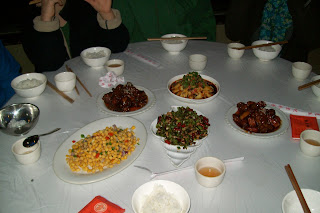 Our last big meal at a nice restaurant. Was quite delicious!
 As a Western Kentucky University alumnus, I of course had to get the traditional "red towel picture at an exotic place." Thrilled to assist, as you can see, was a lady dressed in local traditional attire who was walking around the airport. We think this is traditional dress of the Miao people (pronounced like cat's "meow." Learn more.) As I walked away, she yelled, "Tzi Jen!" which, I believe in her local tongue means "Go Tops!"


Friday, December 21, 2012
Couple More Videos
Duyun in Guizhou province. Every Sunday all the vendors come to town to sell their stuff along one long, busy street. Start to play, then double click for best viewing.
Here's how the locals responded when we told them we were finally leaving.
Saturday, December 15, 2012
Saturday: Temple Hill (Not Kentucky)
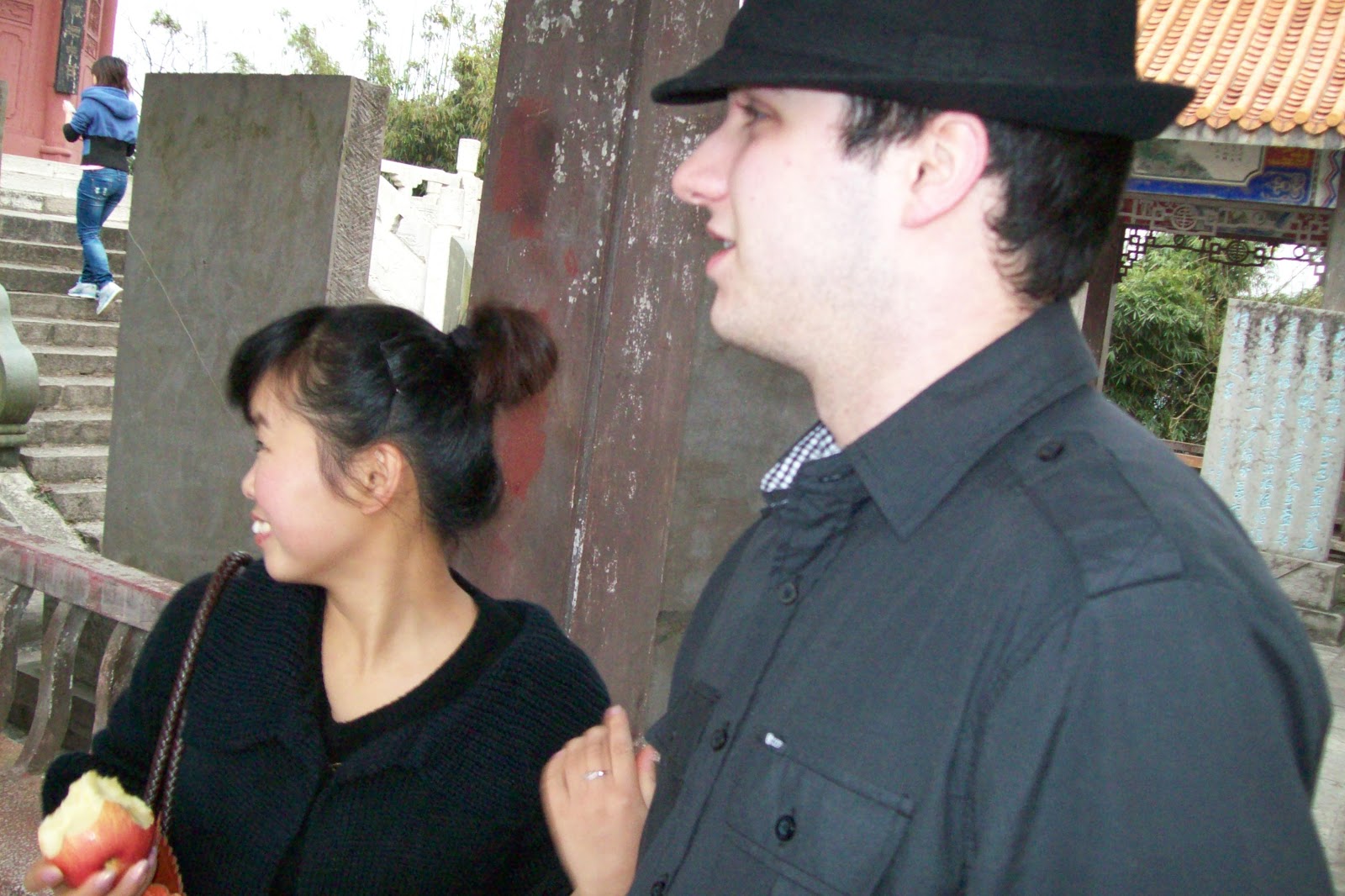
Saturday we climbed up a mountain to a Taoist holy site. (Read more about Taoism.) Experienced a lot: David buys fedora and looks like swanky Euro-dude. Chinese kids swamp us like pigeons around a cracker, wanting to take pictures with us. Wes becomes one with nature, letting out his call of the wild from atop the great mountain. Start to play, then double click for best viewing.
Saturday: River Walk
We walked along the city's river on Saturday.


Luke


"Hmmm. How would he take it if I pushed him into the river right now?"

Ezra

These blue-necks came for the UK game.

Meghan: "Who are these people?"

Hannah and friend: What has obviously maintained mutual respect and cooperation between our two countries is the continual, spontaneous flashing of this sign.


Lydia

Meghan

Micah (Can't figure out what's under that grate.)

Hannah (after eating magic Chinese candy)


No one in China can tell us who this famous Chinese person is.

"Sure you wanna play that card now? No take backs!"


Decided to go out for Chinese.

Walk with your head down a lot? Still can't escape the hounds of advertising!
Friday, December 14, 2012
Farm Trip Video
Took forever to upload this video, so you'd better watch it! I think you'll find it's worth it. HD quality of the farm trip the other day. Amazing landscapes and local village flavor. For best view, click play button below, then double click the video while it's playing.
Friday Downtown and High School
What a great day! The warm sun actually came out all day! We placed ourselves at the cunning wits of Hannah and Meghan to get us around town. It's like skiing; just hang onto the rope and trust that the person driving the boat knows what they're doing and where they're dragging you to.
Below are pictures of the city, which included an extremely enjoyable trip to the city's most prestigious high school. We got to teach them by hanging out at the basketball court and answering their gazillion questions. Good English; some bashful, many very inquisitive. Amazing, vibrant kids. I began to tell them my favorite story that most of us back home are familiar with. They didn't seem to understand much, but some day some of them will. Some day they'll remember us, how the words we said in English translate into their heart language, and the story will touch them.


This girl's English name is Mary. She gave me a Chinese name, Xi Zu Long. The Long part means "dragon," which made me feel extra cool.

Old school desks and chairs piled outside. Just like our kids, they scribble who knows what on them.


A Christmas merchandise shop. I must tell you that it is very red. To the Chinese, Christmas is an enigma wrapped in a mystery, but they kinda like it anyway. Just like back home, it gives stores another angle for selling us stuff.

Below pics are from a local park.


Above tower has some kind of dragon story behind it. Something about one being trapped in it to this very day! They're big on dragons in China, you know.

Meghan, Hannah, and David mixing with the local dignitaries.


Subscribe to:
Posts (Atom)